


Dental Prosthetics & Implants
An Overview of Types of Dental Prosthetics
Which care option is best suited for which situation
Not all dental restorations are the same. Depending on your remaining teeth, bone availability, functional demands, and aesthetic expectations, a wide variety of solutions may be appropriate. The key factor is not what is technically possible, but which restoration is functionally suitable, easy to care for, and a sensible long-term choice for your specific situation. This overview highlights the most important options, along with their strengths and limitations.


Key Points at a Glance
- Dentures are classified as fixed, removable, combination, and implant-supported.
- Crowns and bridges are permanently attached, while partial and full dentures can be removed for cleaning.
- Combined dental prostheses, such as telescopic dentures, combine a secure fit with ease of cleaning.
- The best solution isn't the most elaborate one, but the one that best suits the patient's dentition, bone structure, and ability to maintain oral hygiene.
What types of dentures are there?
Dentistry generally distinguishes between four groups. In many cases, these can also be combined:
- Fixed Dental Restorations: Crowns, bridges, inlays, and veneers—securely attached to teeth or implants.
- Removable Dentures: Partial and full dentures that you can remove and clean yourself.
- Combined Dental Prostheses: Prostheses that are anchored to natural teeth using telescopic crowns or attachments.
- Implant-Supported Dental Restorations: Crowns, bridges, or dentures that are supported by implants.
Fixed dental prostheses for single teeth or small gaps
Crowns and bridges are among the classic types of fixed restorations. A crown protects and stabilizes a severely damaged tooth. You can read more about this in our technical article, “Dental Crowns for Stable Tooth Preservation.” A bridge replaces one or more missing teeth and is supported by the adjacent abutment teeth.
A bridge is highly effective from a functional standpoint. A key drawback of conventional bridges is that the adjacent teeth must be ground down. If these teeth are healthy, this results in a loss of tooth structure. Therefore, it is always important to determine whether a less invasive alternative is available.

Fixed Dentures Without Implants
For those who do not want an implant or for whom an implant is not an option, there are several fixed treatment options. In addition to the conventional bridge, there is the adhesive bridge, also known as a bonded bridge. It is attached with a small wing to the back of an adjacent tooth, which requires little or no grinding.
All-ceramic adhesive bridges have proven particularly effective in the anterior region for replacing single missing teeth. However, they are generally not suitable for larger gaps or heavily loaded posterior teeth.
Removable dentures remain a practical option in many cases
Partial and full dentures continue to play an important role in dental care. They can bridge large gaps, are less invasive than surgical alternatives, and are easy to clean. There are two main types of partial dentures:
- Clasp denture (cast denture): held in place by metal clasps attached to the remaining teeth—tried and true, cost-effective, but the clasps may be visible.
- Full denture: replaces all the teeth in one jaw and stays in place in the upper jaw due to suction against the palate; in the lower jaw, it is often less secure.
Removable dentures require some getting used to and regular adjustments because the alveolar ridge and oral mucosa change over time. Comfort and stability depend heavily on the individual's oral condition.

Combined Dental Prosthetics: Telescopic and Attachment-Retained Dentures
Combined dentures offer the best of both worlds. With a telescopic denture, the remaining natural teeth are first fitted with permanently cemented inner crowns. The denture features precisely fitted outer crowns that slide over them like a telescope, providing excellent stability—without any visible clasps. With an attachment denture, small connecting elements on the crowns serve this purpose.
A major advantage: If another abutment tooth is lost later on, a telescopic denture can usually be extended rather than having to be completely remade. To learn more about how combined dentures work in detail, read our technical article, “Fixed and Removable Dentures.”
Implant-supported solutions expand the possibilities
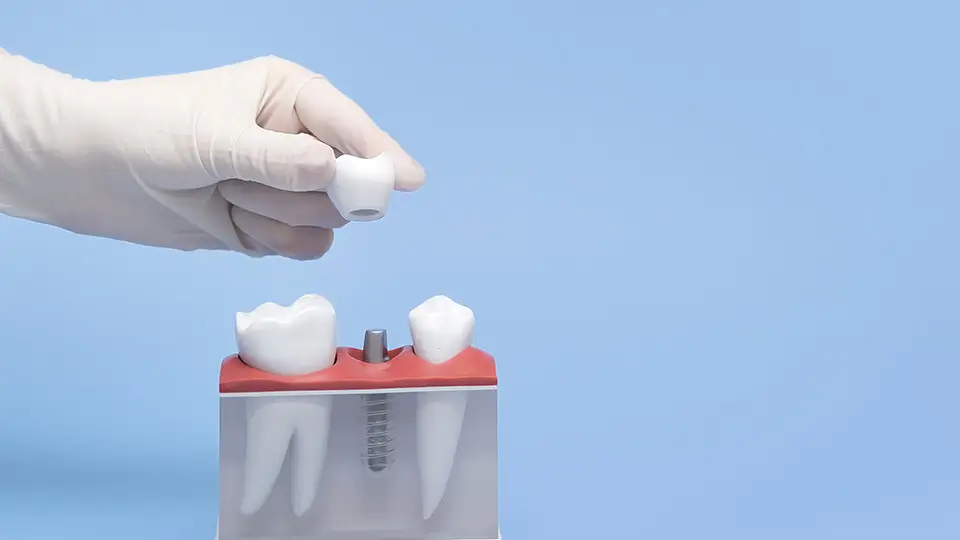
Implants can support individual crowns, bridges, or even removable dentures. This significantly expands the options available, especially when only a few natural teeth remain. Even just two implants in the lower jaw can provide a secure foundation for a full denture. Our expert article, “Dental Implants at the Highest Level,” explains whether an implant or a bridge is the better choice.
Nevertheless, dental implants are not automatically the best solution. Bone availability, overall health, smoking, and the ability to maintain oral hygiene all play a major role. Even implant-supported dentures require consistent follow-up care.

Good care does not mean spending as much as possible
In prosthodontics, it is not the most elaborate solution that counts, but the most appropriate one. The key factors are function, aesthetics, ease of cleaning, and long-term prognosis. Good planning therefore always involves openly discussing the limitations of individual types of dental prostheses and weighing them together. You can read about how we plan dental prostheses in our practice and have them fabricated in our master laboratory on our page about dental prostheses.

From inlays to dentures, made of all-ceramic materials and crafted in a master dental laboratory.
About Our ServicesFrequently Asked Questions
What types of dentures are there?
Generally speaking, dental restorations are classified as fixed, removable, combined, or implant-supported. Fixed solutions include crowns and bridges, while removable solutions include partial or full dentures. Implants, in turn, can support either fixed or removable restorations.
What is the difference between fixed and removable dentures?
Fixed dentures remain permanently in the mouth and are attached to natural teeth or implants. Removable dentures can be taken out of the mouth for cleaning. Which option is better suited depends not only on comfort, but also on the condition of your teeth, the durability of the dentures, and how easy they are to care for.
When is a bridge the better option, and when is an implant preferable?
A bridge may be a good option if the adjacent teeth already have significant damage or need to be stabilized and crowned anyway. An implant has the advantage that adjacent teeth do not need to be prepared. However, it requires sufficient bone, suitable healing conditions, and good oral hygiene. So there is no one-size-fits-all solution.
Are removable dentures a worse option?
No. They are not automatically the second-best option. Especially in cases of extensive tooth loss or limited options, they can be a functional and cost-effective solution. What’s important is a good fit, regular checkups, and a willingness to take good care of the dentures.
Are there any types of dental prosthetics that are particularly gentle on the tooth structure?
Yes. In appropriate cases, adhesive bridges can be a relatively minimally invasive solution because they require little or no preparation of the adjacent tooth. However, they are not suitable for every type of gap and must be planned very carefully.
You Might Also Be Interested In


Contact & Directions
You can find us here
Address
Friedrichstraße 186,
, 10117 Berlin
U Stadtmitte (U2, U6)
U Hausvogteiplatz (U2)
Opening hours
Mon–Thu 8:00 a.m.–8:00 p.m.
Fri 8:00 a.m.–6:00 p.m.
Telephone
Acute pain outside of office hours? Dental emergency service: 030 – 89004-333 or www.kzv-berlin.de


