


Cosmetic Dentistry
Prep and Non-Prep Veneers: Differences, Benefits, Durability, and Scientific Findings
Porcelain Veneers in Berlin: How can teeth be cosmetically corrected while preserving as much natural tooth structure as possible?
Ultra-thin ceramic veneers can be used to correct tooth color, shape, length, and minor irregularities. Which approach—prep or non-prep—is the right one? How long do veneers last, and what does the science say about them?

Key Points at a Glance
- Prep veneers are bonded after targeted preparation that minimizes enamel removal as much as possible, while non-prep veneers are bonded with no or only minimal tooth structure removal.
- Non-prep is not automatically better: What matters is the minimal preparation necessary to achieve a result that is aesthetically pleasing, functionally sound, and biologically favorable.
- Studies show that ceramic veneers have a survival rate of about 95% after ten years—particularly high when bonded to the enamel.
- A mock-up, functional analysis, and the appropriate ceramic (feldspar or lithium disilicate) are the foundation for a long-lasting result.
Ceramic veneers are among the established treatment options in modern cosmetic dentistry. Using wafer-thin ceramic shells, tooth color, shape, length, and minor irregularities can be corrected. Two treatment approaches are central to this: prep veneers, which involve targeted, minimally invasive preparation of the tooth surface, and non-prep veneers, which are bonded with little or no removal of tooth structure.
But which method is better? Are non-prep veneers really less invasive? How long do ceramic veneers last, and what scientific evidence is there regarding their long-term prognosis?
At Schöne Zähne Berlin – Prof. Dr. Olze & Associates, the focus is on individualized treatment planning. The goal is to provide an aesthetically harmonious restoration that preserves as much of the natural tooth structure as possible.
What are prep and non-prep veneers?
In short, veneersare custom-made ceramic shells for the visible surfaces of the teeth. Prep veneers are bonded to the tooth after targeted reduction of the tooth surface, while non-prep veneers complement the existing tooth shape with little or no removal of tooth structure.
Veneers are bonded to the visible surfaces of the teeth using modern adhesive techniques. They are particularly suitable for correcting permanent tooth discoloration, small gaps between teeth, irregular tooth shapes, enamel defects, and worn incisal edges.
Prep veneers are bonded to the teeth after a targeted reduction of the natural tooth surface. The preparation creates the necessary space for the ceramic and allows for harmonious integration into the original tooth contour.
Non-prep veneers are placed without traditional preparation or with only minimal removal of tooth structure. They follow the additive principle: the existing tooth shape is augmented with an additional layer of ceramic.
Both procedures can produce excellent aesthetic results. The key is the correct indication.
| Prep Veneers | Non-Prep Veneers | |
|---|---|---|
| Material removal | Targeted, often approximately 0.3–0.7 mm, preferably in the enamel | none or only minimal |
| Ceramic Thickness | Adapted to the preparation | often about 0.2–0.5 mm |
| Principle | The tooth contour is carefully reshaped | additive – ceramics are supplemented |
| Suitable for | bulky teeth, more extensive corrections to shape or color | small, narrow teeth, gaps, slight irregularities in shape |
| Borders | Preparation is irreversible; avoid exposing dentin | Risk of Overdeveloped Teeth Due to Lack of Space |
Minimal-Prep Veneers: When Is Minimal Preparation Appropriate?
With prep veneers, the vestibular (i.e., visible outer) surface of the tooth is reduced in a targeted manner while preserving as much tooth structure as possible. Preparation depths often range from about 0.3 to 0.7 mm. However, the actual reduction depends on the individual tooth anatomy and the planned ceramic thickness.
This preparation allows for controlled shaping of the final tooth contour, particularly in cases involving teeth that are already large, significant changes in shape, or severe discoloration. The advantages include:
- Harmonious tooth proportions without excessive material thickness
- Controlled Ceramic Thickness and Edge Design
- Better Options for Correcting Existing Tooth Shapes
- Avoiding overly contoured transitions to the gums
- Targeted Aesthetic Color Corrections

A particularly important factor is the preservation of tooth enamel. Due to its mineralized structure, it provides excellent conditions for adhesive bonding. Therefore, the preparation should remain within the enamel as much as possible.
Extensive dentin exposure can adversely affect the long-term prognosis, as the adhesive bond to dentin is technically more challenging and more sensitive to moisture.
Non-Prep Veneers: Aesthetics Without Traditional Tooth Preparation
Non-prep veneers allow for aesthetic dental correction without the need for conventional reduction of the natural tooth surface. Modern ceramic systems enable the creation of very thin veneers, whose thickness often ranges from about 0.2 to 0.5 mm, depending on the material and indication. Non-prep veneers are particularly suitable for:
- small or narrow teeth
- congenital structural defects
- Selected tooth gaps and diastemas
- minor irregularities in tooth shape
- certain enamel defects
- Proper tooth alignment with sufficient space for the additional ceramic
The most important advantage is the maximum preservation of natural tooth structure. Since the tooth surface is largely preserved, this also creates favorable conditions for adhesive bonding.
However, non-prep veneers are not suitable for every dental situation. If they are applied to teeth that are already large, the additional thickness of the material can result in overcontoured teeth. This can compromise aesthetics and make it more difficult to clean between the teeth. The transitions at the neck of the tooth must also be carefully designed to ensure that the gums remain healthy.
The key is to use the least amount of tooth preparation necessary to achieve a restoration that is aesthetically pleasing, functional, and biologically favorable.
What does science say about the durability of veneers?
In short: Whenindicated appropriately and secured with high-quality adhesive bonding, ceramic veneers achieve good long-term survival rates—around 95% after ten years, according to review studies. Bonding to the enamel is particularly effective.
The influence of the bonding substrate is particularly relevant. A systematic review with meta-analysis by Alqutaibi and colleagues in 2025 examined the clinical prognosis of ceramic veneers on different tooth surfaces. The results indicate particularly favorable survival rates when bonded to enamel. Less favorable results were observed with increasing dentin exposure (original study).
Another systematic review by Alenezi et al. in 2021 evaluated a total of 25 clinical studies involving 6,500 porcelain veneers. The estimated cumulative survival rate after ten years was 95.5%. The most common complications included ceramic fractures and detachments (original study).
The choice of material also influences the clinical prognosis. A meta-analysis by Klein and colleagues examined various ceramic veneer materials (original study). The pooled survival rates after an average of about ten years were as follows:
- Feldspar ceramics: 96.13%
- Leucite-reinforced glass-ceramic: 93.70%
- Lithium disilicate: 96.81%
The results make it clear that a material’s mechanical strength alone does not determine its long-term success. Equally important are preparation, maintenance of the cast, adhesive retention, and functional loading.
What type of ceramic is suitable for veneers?
Feldspar ceramic and lithium disilicate are the materials most commonly used for ceramic veneers.
Feldspar ceramics have excellent optical properties and high translucency. They produce a particularly natural light effect and are suitable for highly aesthetic anterior restorations. Due to their lower mechanical strength, careful consideration of the indications is required.
Lithium disilicate combines good aesthetic properties with greater mechanical strength. The material is versatile and is suitable for both minimally invasive and conventionally prepared veneers.
The choice of material depends on the base color, the desired translucency, the required material thickness, and the functional requirements.
What does the veneer procedure involve?
- Examination: The position , shape, and color of the teeth, as well as the tooth structure, gums, and functional relationships, are comprehensively assessed.
- Planning: The desired result is planned using Digital Smile Design and a diagnostic wax-up.
- Mock-up: The planned tooth shapes are temporarily placed in the mouth—this allows you to evaluate the result before the final restoration is placed.
- Deciding Between Prep and Non-Prep: Only then is a decision made as to whether a minimally invasive preparation or a non-prep approach is appropriate.
- Trial Fitting and Bonding: The custom-made ceramic shells are tried on and, after surface preparation, bonded in place.
- Check: The marginal design , occlusion, and dynamic tooth contacts are checked one last time.

Regular checkups and thorough oral hygiene are crucial for the long-term health of your teeth and gums.
Bruxism and Functional Stress
For patients with bruxism—that is, nighttime teeth grinding or clenching—veneer planning must be carried out with particular care. Increased mechanical stress can raise the risk of ceramic fractures, chipping, and detachment.
For this reason, static and dynamic occlusion, as well as any parafunctional stresses, should be evaluated prior to treatment. If indicated, a custom-made protective splint may be beneficial. Learn more on our page about TMD treatment and in the professional article “Veneers for Worn Teeth.”
Scientific Guidelines and Recommendations
There is currently no standalone AWMF S3 guideline specifically for prep and non-prep veneers. However, the S3 guideline “All-Ceramic Crowns and Bridges” issued by the DGPro and DGZMK provides an important scientific foundation. The previous version was published in 2021 and was valid through February 2026. An update has been submitted to the AWMF.
In addition, the 2025 international consensus document on minimally invasive ceramic dentistry is relevant. It addresses the survival rates and complication rates of ceramic partial restorations and veneers. All sources can be found at the end of this article.
Prep or Non-Prep: Which Is the Better Choice?
In short, italways depends on the individual's dental situation. Non-prep veneers are suitable for small teeth, gaps, and favorable anatomy; prep veneers are often a better option when significant shape correction is needed or the teeth are already large.
Non-prep veneers can be a particularly tooth-preserving solution for small teeth, diastemas, and favorable anatomical conditions. Prep veneers, on the other hand, are often more appropriate when significant shape correction is necessary, when the teeth are already large, or when the goal is to achieve a harmonious contour without oversizing.

The scientific evidence particularly underscores the importance of adhesive retention that minimizes enamel removal as much as possible.
At Schöne Zähne Berlin – Prof. Dr. Olze & Associates, the focus is therefore not on minimizing tooth preparation at any cost, but rather on selecting the treatment plan that offers the best long-term combination of tooth preservation, aesthetics, and function.
Your Healthcare Providers
Who will treat you for veneers?
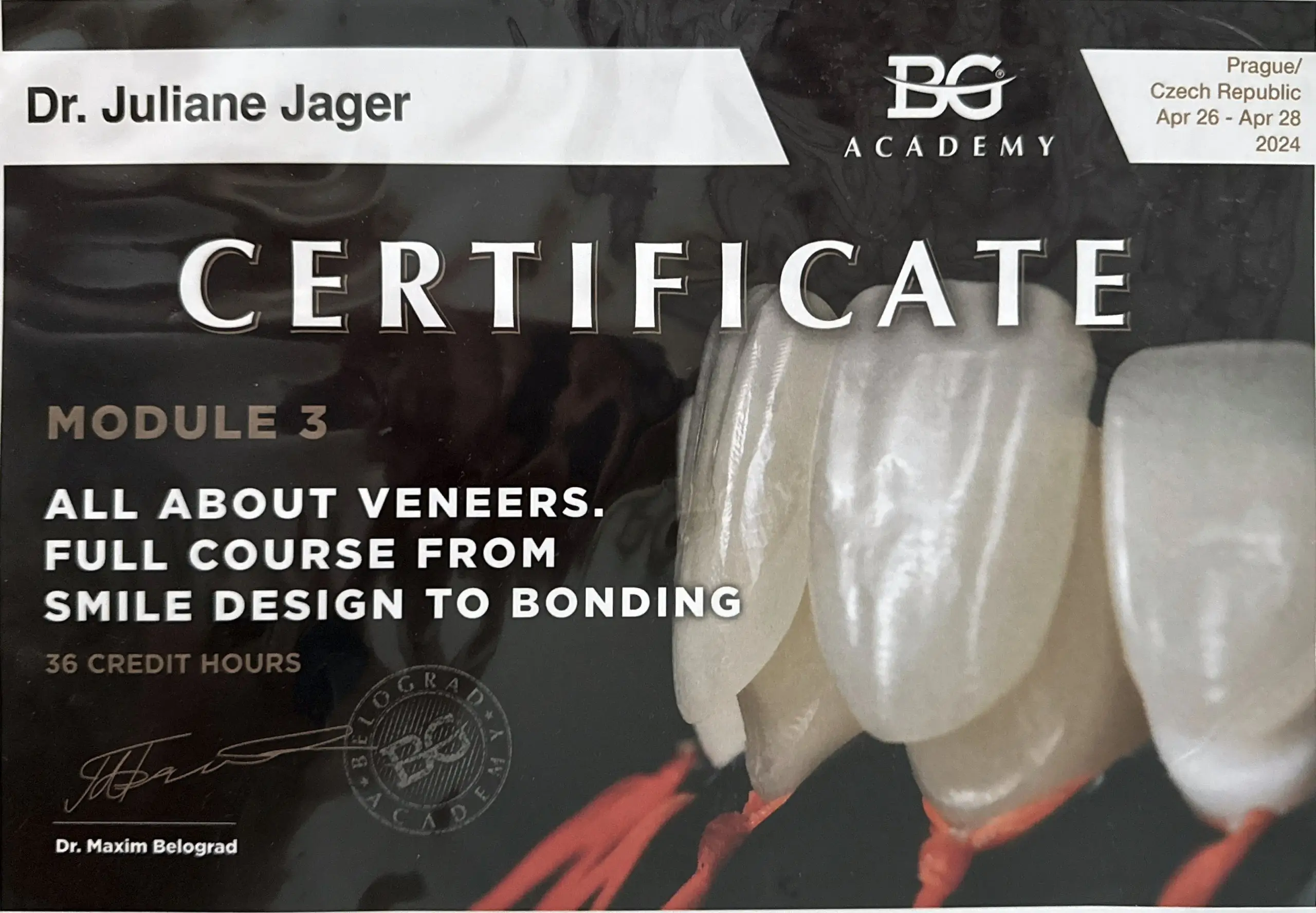
Whether prep or non-prep veneers: We make the decision at our practice in Berlin Mitte after joint planning as a team—with Dr. Juliane Jager serving as our highly trained specialist for veneers.
 Scientific Director · Responsible for this articleProf. Dr. med. dent. Andreas OlzeDirector of Dentistry and Adjunct Professor at Charité. With many years of experience in complex prosthetics and aesthetic reconstructions—including numerous veneer restorations—he is responsible for the overall planning of your treatment.About Me

Focus on Veneers & Aesthetics
Dr. Juliane Jager, M.Sc.
Dr. Jager has completed specialized training in veneers and aesthetic anterior tooth restorations. She will work with you to determine how much tooth preparation is truly necessary—and when a no-prep approach is the better choice.
We're here for you, too


Read more: Related articles
- Veneers for Worn Teeth: Function First, Aesthetics Second
- Digital Smile Design
- Anterior Tooth Restorations with Ceramic
- A dentist and dental technician all in one
- MODJAW® and 4D Functional Diagnostics

Teeth whitening, veneers, and all-ceramic restorations for a naturally beautiful smile.
About Our ServicesFrequently Asked Questions
What is the difference between prep and non-prep veneers?
Prep veneers are bonded to the teeth after a targeted reduction of the natural tooth surface. Non-prep veneers require no traditional preparation or only minimal removal of tooth structure. Both procedures allow for aesthetic dental corrections, but differ in terms of indications, space requirements, and design options.
Are non-prep veneers better than prep veneers?
Not necessarily. Non-prep veneers preserve more natural tooth structure, but they are only appropriate for certain tooth shapes and when there is sufficient space. For teeth that are already large, minimal preparation can lead to a significantly more natural-looking result.
Do teeth always have to be filed down for veneers?
No. If the tooth anatomy is suitable, non-prep veneers can be placed without traditional preparation. Whether preparation is necessary depends on the tooth's position, the available space, and the desired change in shape.
How much tooth structure is removed during the preparation for veneers?
The preparation depth is often between about 0.3 and 0.7 mm. The actual depth depends on the individual tooth anatomy and the planned ceramic thickness. The goal is to preserve as much enamel as possible.
How thin can non-prep veneers be?
Depending on the ceramic system and fabrication method, non-prep veneers can be approximately 0.2 to 0.5 mm thick. The required material thickness depends on the individual clinical situation and the planned tooth shape.
Are non-prep veneers completely painless?
Since little or no preparation is required, the procedure is often relatively comfortable. Whether local anesthesia is necessary depends on the specific procedure. Complete freedom from pain cannot be guaranteed.
How long do ceramic veneers last?
Systematic reviews show that ceramic veneers have a survival rate of approximately 95% after ten years. With appropriate indications, high-quality bonding, and good oral hygiene, veneers can last significantly longer. However, individual longevity cannot be guaranteed.
Can veneers fall off after a few years?
Detachment, known as debonding, is a possible complication. Causes may include an inadequate adhesive bond, contamination during bonding, structural changes, or excessive mechanical stress.
What happens if a veneer breaks off?
For minor chips, a composite repair may be possible, depending on the nature of the defect. For larger fractures, a replacement is often necessary. The decision depends on the condition of the tooth and the remaining ceramic.
Are veneers harmful to natural teeth?
When indicated appropriately and performed properly, veneers can be a restorative treatment that preserves tooth structure. However, tooth preparation is irreversible. Therefore, as much of the natural tooth structure as possible should be preserved.
Can veneers prevent tooth decay?
No. Veneers do not protect against tooth decay. The natural tooth surfaces—especially the junctions between the ceramic and the tooth—must still be carefully maintained.
Can you eat normally with veneers?
Yes. Once the restoration has been successfully placed, patients can generally eat normally. However, they should avoid using their front teeth to bite into very hard objects, such as nut shells or ice cubes.
Can veneers discolor?
High-quality ceramic is highly color-stable and discolors significantly less than natural teeth or composite materials. However, the margins or exposed natural tooth surfaces may change color.
Can veneers be used on severely discolored teeth?
Yes. Porcelain veneers can also be used in cases of severe discoloration. However, the choice of porcelain, its translucency, and the required material thickness must be tailored to the initial tooth color. In such cases, minimal preparation may be necessary.
Can veneers be used on crooked teeth?
In certain cases, mild misalignments of the teeth can be corrected for aesthetic reasons. For severe misalignments, orthodontic treatment is often the gentler alternative for the teeth.
Can veneers be used to close gaps between teeth?
Yes. In cases of diastema in particular, veneers can correct the proportions of the teeth and close gaps between them. Care must be taken to ensure that this does not result in excessively wide teeth or unfavorable gum contours.
Are veneers an option for bruxism?
Yes, but the increased mechanical stress must be taken into account. A functional examination and, if necessary, a custom-made protective splint are recommended.
Are non-prep veneers reversible?
They preserve more natural tooth structure, but should not be generally described as reversible. The adhesive bonding and subsequent removal can cause changes to the tooth surface.
Can veneers be replaced later?
Yes. If medically indicated, old veneers can be removed and replaced with new restorations. In doing so, the remaining tooth structure must be taken into account.
Can veneers be attached to teeth that already have crowns?
A traditional veneer restoration on a tooth that already has a crown is generally not advisable. In such cases, it is necessary to determine whether the crown needs to be replaced or whether another restorative solution is required.
Are veneers better than dental crowns?
If there is sufficient healthy tooth structure remaining, veneers can be a significantly less invasive alternative to a full crown. In contrast, for severely damaged teeth or extensive defects, a partial crown or a full crown may be more appropriate.
Can veneers permanently change the color of your teeth?
Yes. Ceramic veneers allow for a long-term change in the visible color of the teeth. The final color result is influenced by the ceramic material, translucency, material thickness, and the bonding composite.
How many veneers do you need for a beautiful smile?
That depends on the individual alignment of the teeth, the width of the smile, and the desired aesthetic change. Sometimes two to four veneers are sufficient; in other cases, it may make sense to treat several front teeth.
How long does a veneer procedure take?
The duration depends on the diagnostic evaluation, treatment planning, the number of teeth, and the fabrication of the dental prostheses. Once the treatment plan is finalized, several appointments are often required.
Is it a good idea to create a mock-up before treatment?
Yes. A mock-up allows you to evaluate the planned tooth shapes in the mouth before the final restoration is placed. This makes it easier to assess proportions, length, and aesthetic impact.
Can veneers irritate the gums?
Yes, gingival irritation can occur, particularly when restoration margins are overcontoured or transitions are poorly designed. That is why careful margin design and good oral hygiene are crucial.
How do you properly care for veneers?
Veneers should be cared for just as carefully as natural teeth. This includes brushing twice a day with an appropriate toothbrush, cleaning between your teeth daily, and having regular dental checkups.
Is it possible to have a professional teeth cleaning with veneers?
Yes. A professional dental cleaning is also recommended for patients with veneers. However, the instruments and polishing agents used should be appropriate for the existing ceramic restorations.
How much do prep and non-prep veneers cost in Berlin?
The cost depends on the number of veneers, the material used, the dental work involved, and the individual treatment situation. A binding cost estimate can only be provided after an examination and treatment planning.
Which veneers are right for me?
This can only be assessed through a clinical examination. Key factors include the remaining tooth structure, tooth position, tooth shape, color, gum condition, and functional stress. A customized treatment plan makes it possible to select the restoration that preserves the most tooth structure while also providing the best aesthetic result.
Scientific Basis
Guidelines & Reference Materials on This Topic
There is currently no standalone AWMF guideline specifically for prep and non-prep veneers. The S3 guideline “All-Ceramic Crowns and Bridges” addresses all-ceramic restorations in general; its validity period ended in February 2026, and an update has been announced. In addition, the article draws on current meta-analyses and an international consensus.
- S3 GuidelineAll-Ceramic Crowns and Bridges (DGPro, DGZMK)AWMF 083-012 · 2021 · Validity expired, update pendingPDF
- ConsensusSurvival and Complication Rates of Ceramic Partial-Coverage Restorations and Ceramic Laminate Veneers – Consensus Statement (SSRD, SEPES, PROSEC)J Esthet Restor Dent · 2025DOI
- Meta-analysisAlqutaibi et al.: Clinical Survival and Complication Rate of Ceramic Veneers Bonded to Different SubstratesJ Prosthet Dent · 2025DOI
- Meta-analysisKlein et al.: Survival and Complication Rates of Feldspathic, Leucite-Reinforced, Lithium Disilicate, and Zirconia Ceramic Laminate VeneersJ Esthet Restor Dent · 2025DOI
- ReviewAlenezi et al.: Long-Term Survival and Complication Rates of Porcelain Laminate Veneers in Clinical StudiesJ Clin Med · 2021DOI
- ReviewLayton & Clarke: Survival Rates for Porcelain Laminate Veneers, with Special Reference to the Effect of Dentin PreparationJ Esthet Restor Dent · 2013DOI
Guidelines are decision-making tools for dentists. We’ll determine which treatment is right for you during a personal consultation.
You Might Also Be Interested In

Cosmetic Dentistry
Cosmetic dentistry doesn't always start with veneers: Why function is the foundation of a beautiful smile


Contact & Directions
You can find us here
Address
Friedrichstraße 186,
, 10117 Berlin
U Stadtmitte (U2, U6)
U Hausvogteiplatz (U2)
Opening hours
Mon–Thu 8:00 a.m.–8:00 p.m.
Fri 8:00 a.m.–6:00 p.m.
Telephone
Acute pain outside of office hours? Dental emergency service: 030 – 89004-333 or www.kzv-berlin.de


